



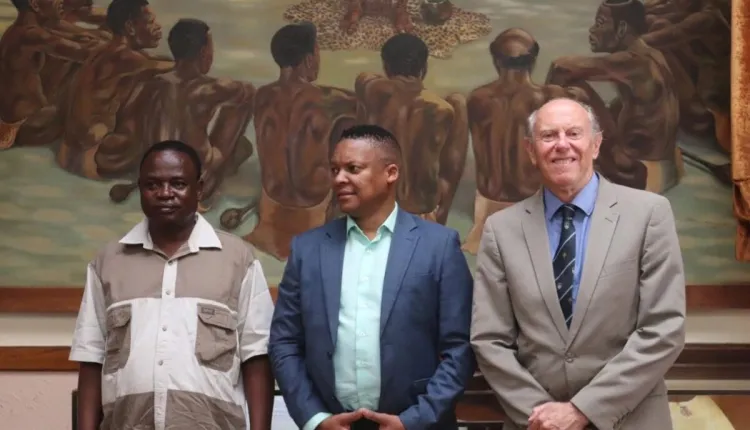
The audacious pronouncements of Zimbabwe’s Minister Daniel Garwe regarding the Lobengula Kingship constitute not only an egregious overreach of his ministerial authority but also a blatant affront to the very essence of the Ndebele people’s ethnocultural heritage.
Bulelani Khumalo’s claim, firmly rooted in demonstrable lineage to the last Ndebele monarch, Lobengula, represents a profound and legitimate aspiration for cultural resurgence and the restoration of a foundational pillar of Matebeleland’s identity.
Minister Garwe’s presumptuous attempt to discredit this deeply significant claim demands the most rigorous interrogation, unequivocally exposing the insidious political motives and the inherent illegitimacy of his unwarranted intervention.
Khumalo’s assertion of his royal lineage is no mere sentimental pursuit; it is a claim powerfully buttressed by the enduring weight of historical memory and meticulously preserved genealogical evidence held sacred within the Ndebele community.
The Ndebele kingdom, a historically significant and culturally rich pre-colonial entity, indelibly shaped the socio-political landscape of what is now Zimbabwe.
The profound yearning for the restoration of its symbolic leadership is an authentic and vital expression of cultural continuity, a resolute desire to reclaim a dignified and integral past that colonial forces sought to extinguish.
In stark and unacceptable contrast, Minister Garwe’s pronouncements reek of blatant political expediency and a chilling disregard for the sacrosanct nature of traditional institutions. His arrogant attempt to delegitimise Khumalo’s claim ignites fundamental questions about the legitimate scope of his ministerial portfolio and the sinister underlying motivations driving his audacious interference.
As a dedicated advocate for social justice, I assert with unwavering conviction that Minister Garwe’s intervention lies demonstrably and unequivocally outside the legitimate purview of his responsibilities.
One is compelled to pose the critical and unsettling question: what perverse agenda compels a government minister to so brazenly intrude upon the deeply cultural and historical affairs of a specific and historically marginalised ethnic group?
Several disturbingly plausible explanations emerge from this egregious overreach:
*Paralysing Fear of Matabeleland’s Resurgent Unity: The most compelling and politically charged explanation lies in the palpable fear within certain echelons of power regarding the potent potential for a restored Ndebele kingship to galvanise a powerful and unified front amongst the people of Matebeleland. A legitimately recognised king could swiftly become a central and authoritative figurehead for articulating long-standing regional grievances, fostering an unshakeable sense of collective identity, and potentially posing a significant challenge to the rigidly centralised authority of the state. This perceived existential threat to the current power dynamics could be the primary and insidious impetus behind the Minister’s preemptive and heavy-handed strike.
*Cynical Pursuit of Political Relevance: Another disturbingly plausible, albeit far more cynical, interpretation posits that Minister Garwe’s intervention is a transparently self-serving manoeuvre to desperately grasp at political relevance by inserting himself into a high-profile and emotionally charged issue. By publicly and aggressively denouncing a deeply resonant cultural movement within Matebeleland, he may be calculatingly seeking to ingratiate himself with specific factions within the ruling establishment or to project a spurious image of unwavering and ruthless loyalty to the central government.
*Deep-Seated Disregard for Cultural Autonomy: The Minister’s actions could also stem from a more deeply ingrained and profoundly troubling disregard for the fundamental cultural autonomy and inherent right to self-determination of diverse ethnic groups within Zimbabwe. A dangerously centralised and homogenising mindset might inherently view the organic revival of traditional leadership as an unwelcome and potentially destabilising assertion of distinct cultural heritage, one that must be ruthlessly suppressed.
The implications of Minister Garwe’s actions extend far beyond the Ndebele people. His blatant disregard for cultural autonomy and his willingness to overstep his constitutional mandate to undermine a community’s heritage should send a chilling warning to every ethnic group within Zimbabwe.
Under a presidency that condones or even encourages such overreach by its ministers, no ethnicity would be safe from arbitrary interference in their cultural and traditional affairs. This sets a dangerous precedent where political expediency trumps fundamental rights, and the rich tapestry of Zimbabwe’s cultural diversity is threatened by the whims of those in power.
It is absolutely crucial to underscore the stark and unacceptable imbalance of power inherent in this deeply troubling scenario. A government minister, wielding the considerable coercive authority of the state, is attempting to negate the deeply held cultural aspirations of a community profoundly and historically invested in its ancestral heritage.
This arrogant act not only demonstrates a profound disrespect for the Ndebele people but also establishes a dangerously authoritarian precedent for unwarranted state interference in the most fundamental aspects of cultural life.
The inherent cultural authority vested in a traditional kingship, derived from unbroken ancestral legitimacy and profound communal acceptance, fundamentally transcends the transient political authority arbitrarily bestowed by government appointment.
To even suggest that a government minister possesses the prerogative to unilaterally invalidate a people’s sacred cultural heritage is a brazen assertion of political dominance over fundamental cultural autonomy and self-determination.
In conclusion, Minister Garwe’s intervention in the Lobengula Kingship matter is a transparently politically motivated act, utterly devoid of legitimate basis, and demonstrably reveals a chilling disrespect for the foundational cultural heritage of the Ndebele people.
My considered assessment, as an advocate for social justice deeply familiar with this context, remains resolute: this intervention lies demonstrably outside the Minister’s legitimate mandate and ignites profoundly disturbing questions regarding his underlying and likely self-serving motives.
The root causes of this egregious interference likely lie in a deep-seated fear of a unified and empowered Matebeleland and the perceived threat this poses to centralised power, or perhaps in a more opportunistic and cynical pursuit of fleeting political relevance.
Regardless of the specific insidious motivation, this deeply troubling episode serves as a stark and urgent reminder of the perpetually fragile balance between state authority and the fundamental right of communities to preserve, celebrate, and revitalise their unique and invaluable cultural identities.
A robust and balanced academic assessment unequivocally and forcefully concludes that Minister Garwe’s pronouncements constitute an unwarranted, unacceptable, and deeply damaging intrusion into the very fabric of the Ndebele nation’s ethnocultural existence, and furthermore, signals a dangerous erosion of cultural rights for all ethnic groups under the current political climate.