



Abstract:
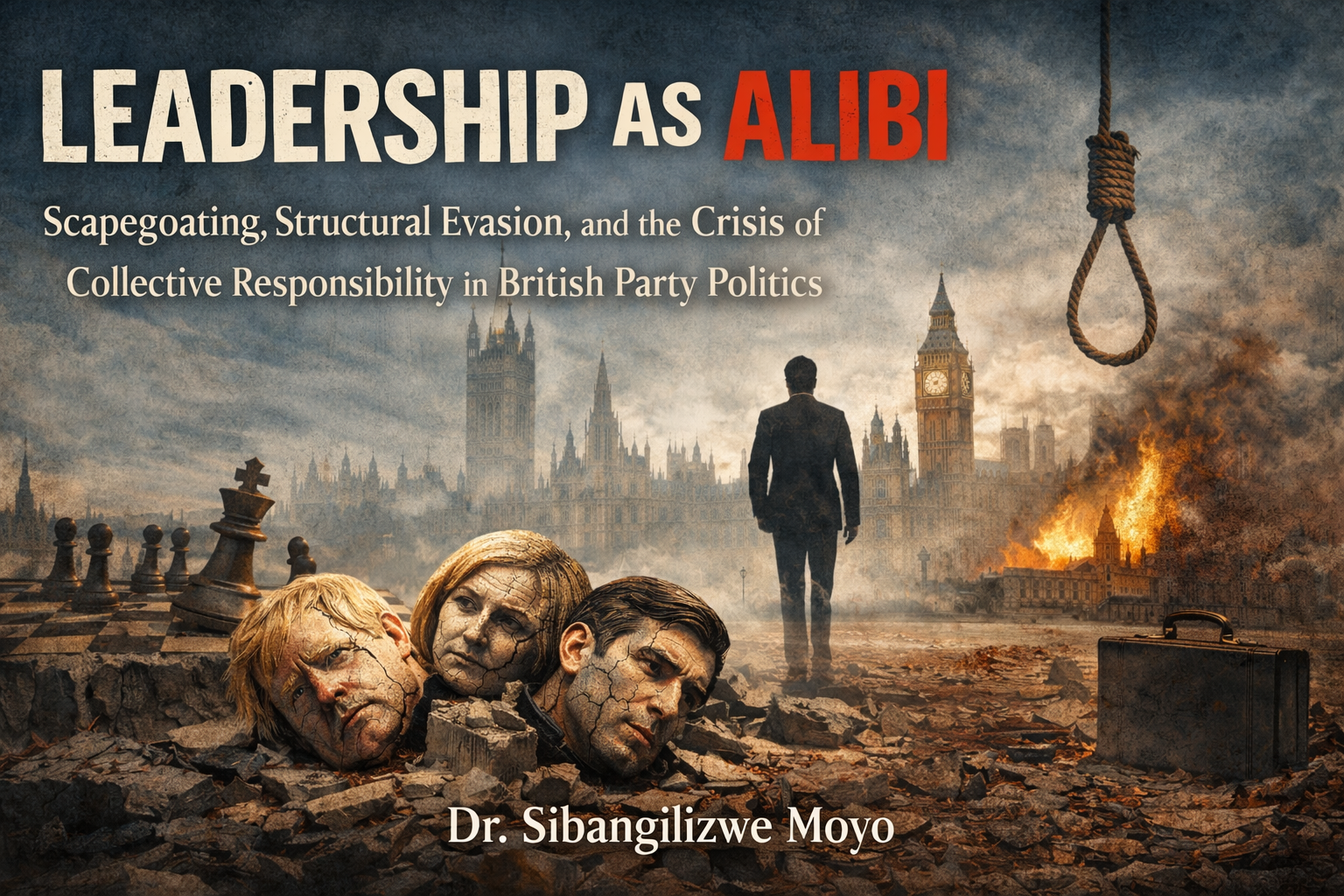
Contemporary British politics has become increasingly preoccupied with leadership removal as a primary mechanism of accountability. This article argues that such fixation represents not democratic vigilance but a displacement strategy: a personalised politics that substitutes leader sacrifice for structural reckoning. Through an examination of recent Conservative leadership churn and its emerging parallels within Labour, the paper contends that British parties are trapped in a cycle of symbolic decapitation that obscures deeper failures in political economy, institutional capacity, and ideological coherence. Leadership change, far from catalysing renewal, has become an alibi for avoiding collective responsibility.
Introduction: From Accountability to Displacement
Leadership accountability is a cornerstone of parliamentary democracy. Yet when leadership change becomes routinised, reflexive, and detached from substantive programmatic reassessment, it ceases to function as accountability and instead becomes a mechanism of evasion. British politics now exhibits precisely this pathology. The removal of leaders has become the dominant response to political failure, crowding out more demanding forms of collective self-critique.
This article advances the claim that British party politics has entered a phase of scapegoat institutionalism: a mode of governance in which individual leaders are repeatedly sacrificed to preserve underlying policy orthodoxies, factional balances, and economic assumptions. In this context, political failure is personalised, while structural causality is systematically disavowed. The result is a politics that marks the man rather than the ball.
The Conservative Case: Serial Decapitation Without Reckoning
The Conservative Party since 2016 provides the clearest empirical illustration of this syndrome. The rapid succession of Boris Johnson, Liz Truss, and Rishi Sunak has often been narrated as evidence of individual inadequacy — moral, intellectual, or managerial. Such interpretations are not without merit, yet they are analytically insufficient.
Johnson’s premiership collapsed under the weight of scandal and ethical degradation, Truss’s under the implosion of a radically under-theorised economic experiment, and Sunak’s under the slow suffocation of technocratic inertia. However, each leadership failure was treated as discrete and self-contained, rather than as an expression of a shared structural context: the unresolved contradictions of Brexit, the hollowing-out of state capacity, the financialisation of economic governance, and a party increasingly unable to articulate a coherent theory of the public good.
Leadership change thus functioned as a ritual of purification. Each removal was framed as a reset, an opportunity for renewal without rupture. Yet the ideological and institutional architecture of Conservative governance remained largely intact. The market fundamentalism, centralisation of power, erosion of public services, and short-term fiscalism persisted. In this sense, leadership churn served to stabilise the system by localising blame, thereby insulating deeper assumptions from challenge.
The Metastasis of the Syndrome: Labour and the Personalisation of Disquiet
More troubling is the extent to which this displacement logic now threatens to migrate beyond the Conservative Party. Labour, historically the principal site of structural critique in British politics, increasingly risks reproducing the same personalised mode of internal contestation.
Internal tensions — over electoral strategy, ideological direction, moral positioning, and the limits of managerial competence — are increasingly refracted through leadership suspicion rather than programmatic debate. The leader becomes the vessel into which all anxieties are poured. Structural questions about the nature of contemporary capitalism, the fiscal constitution of the state, and the reimagining of public ownership are deferred, while leadership loyalty becomes the proxy terrain of struggle.
This represents a significant transformation in political culture. Parties cease to function as collective intellectual projects and instead become arenas of personality management. The language of politics shifts from ideas to optics, from political economy to performance. In such a climate, leadership removal is falsely imbued with transformative potential.
Collective Irresponsibility and the Hollowing of Party Politics
At the core of this phenomenon lies a deeper erosion: the decline of collective responsibility. Modern British parties increasingly resemble fragile coalitions of factions bound together by electoral arithmetic rather than shared analysis. When contradictions inevitably surface, leadership removal becomes the least destabilising option. It allows parties to appear responsive while avoiding the distributive, ideological, and institutional conflicts that genuine renewal would require.
This dynamic has corrosive democratic consequences. To the electorate, perpetual leadership turnover signals a political class preoccupied with internal survival rather than public purpose. Trust erodes not because leaders fail — failure is intrinsic to governance — but because failure is never owned collectively. Responsibility is individualised; learning is privatised; institutions remain inert.
Moreover, this culture produces risk-averse governance. Leaders operating under constant threat of removal prioritise tactical caution over strategic reform. Long-term projects — industrial strategy, welfare transformation, constitutional renewal — are sacrificed to short-term credibility management. Politics becomes administrative rather than imaginative.
Conclusion: Beyond Decapitation Politics
British politics does not suffer from an excess of flawed leaders. It suffers from a deficit of structural courage. The repeated removal of leaders without corresponding ideological and institutional reconstruction represents not renewal but denial — elegant in its simplicity, destructive in its consequences.
Until political parties recover the capacity for collective self-interrogation — confronting failed economic models, interrogating state capacity, and rearticulating the social contract — leadership change will remain a theatrical gesture. The ball will continue to roll unattended while attention remains fixed on the man.
Leadership matters. But when leadership becomes an alibi for avoiding systemic change, it ceases to be a solution and becomes part of the problem. In marking the man rather than the ball, British politics risks condemning itself to perpetual motion without progress.